

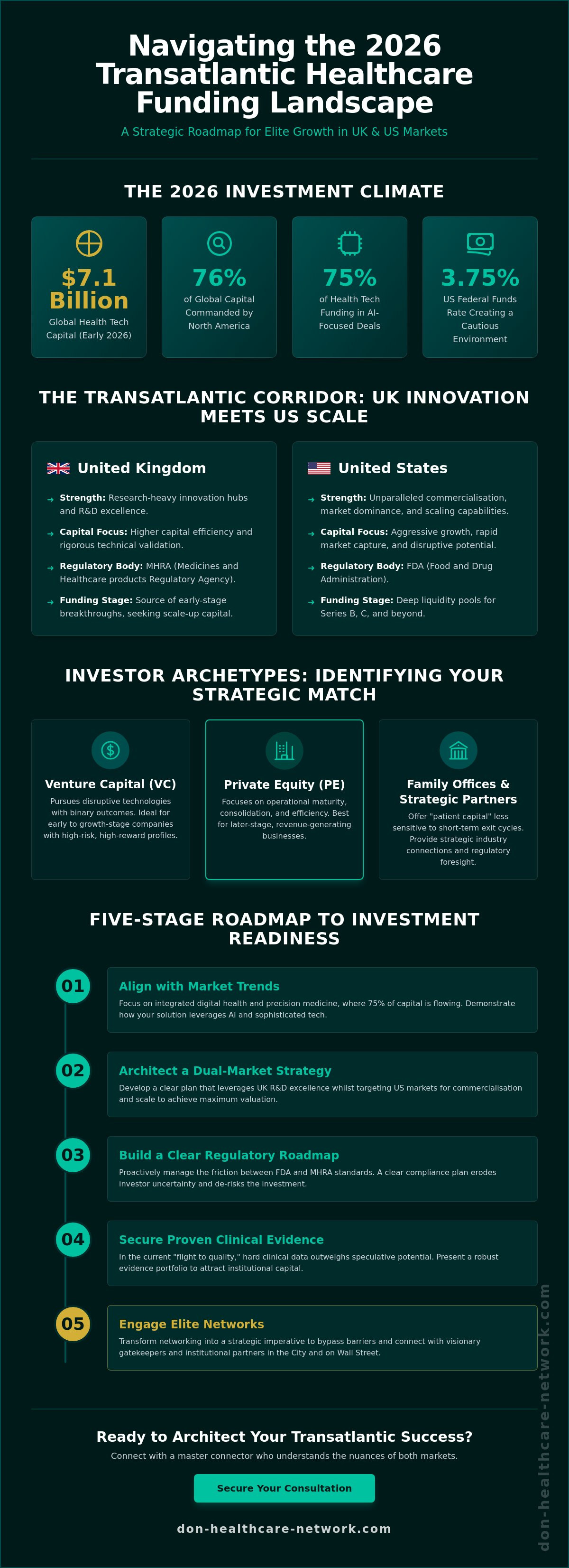
With the US Federal Funds Rate holding at 3.75% and North America commanding 76% of the $7.1 billion global health tech capital in early 2026, the barrier to entry has never been more precise. A sophisticated transatlantic healthcare funding strategy is no longer an optional expansion; it's the architectural requirement for elite growth. You likely recognise that the friction of fragmented regulations and the difficulty of accessing high-level investors without a warm introduction creates a ceiling for most firms. Misaligned valuation expectations across the primary transatlantic capital markets continue to stall ambitious founders who lack a structured approach to global capital.
This guide provides the roadmap to master these complexities and secure significant investment across both markets. You'll learn how to align your clinical evidence with the demands of an exclusive circle of healthcare-specific investors. We'll explore the mechanics of market positioning for global scale, ensuring your regulatory roadmap and capital strategy work in perfect synchronisation. By the end of this article, you'll understand how to navigate the current high-interest environment to emerge as a dominant institutional pillar in the transatlantic corridor.
Key Takeaways
- Identify the 2026 shifts in digital health and precision medicine to align your growth with the primary magnets for high-stakes capital.
- Master a sophisticated transatlantic healthcare funding strategy that effectively bridges the gap between UK innovation and the aggressive scale of the US market.
- Evaluate the distinct investment criteria used by US venture capital versus UK private equity to optimise your proposition for specific geographic valuation expectations.
- Execute a rigorous five-stage roadmap to achieve "Investment Readiness" before attempting to enter the exclusive circles of elite US healthcare investors.
- Transform networking into a strategic business development imperative to bypass traditional barriers and connect with visionary gatekeepers and institutional partners.
The Transatlantic Healthcare Funding Landscape in 2026
A successful transatlantic healthcare funding strategy is defined by the strategic flow of capital and resources between the UK and US healthcare ecosystems. It isn't just about moving money. It's about architectural alignment. In 2026, the investment landscape has pivoted sharply towards integrated digital health and precision medicine. These sectors act as primary magnets for institutional capital. With AI-focused deals comprising 75% of all health tech funding, the demand for sophisticated, tech-enabled solutions is absolute.
The UK remains a powerhouse of research-heavy innovation hubs, yet the US offers unparalleled commercialisation and scaling capabilities. To achieve maximum valuation in the current fiscal year, a dual-market approach is essential. Investors no longer reward regional players. They back global contenders who can bridge the gap between British laboratory breakthroughs and American market dominance. The 2026 landscape is defined by a flight to quality, where proven clinical evidence outweighs speculative potential.
The Convergence of UK Innovation and US Capital
UK-based healthcare startups are increasingly looking to the US for Series B and C funding to access deeper liquidity pools. US institutional investors play a critical role in de-risking early-stage British biotech firms by providing the capital depth needed for expensive clinical trials and market entry. This partnership allows British firms to retain their R&D excellence whilst leveraging American growth expertise. The Transatlantic Corridor is the most vital route for healthcare scale-ups in 2026.
Identifying Structural Barriers in Cross-Border Investment
Market entry is complicated by differing regulatory standards, specifically the friction between the FDA and the MHRA. These disparities can erode investor confidence if not managed through a clear compliance roadmap. Whilst foundational transatlantic trade frameworks have historically sought to align these markets, private capital must still contend with the realities of the US Inflation Reduction Act and its impact on drug pricing. These regulatory shifts force companies to account for government-negotiated prices much earlier in their development lifecycle.
Currency fluctuations also impact long-term funding commitments, especially with the US Federal Funds Rate at 3.75% and the ECB at 2.25%. This financial pressure creates a cautious environment where mature, late-stage companies are favoured. Bridging these geographic and cultural gaps in high finance requires a master connector. Success depends on having a partner who understands the nuances of both the City of London and Wall Street, ensuring that valuation expectations are aligned before the first pitch deck is shared.
Profiling Healthcare Investors: Identifying Your Strategic Match
Refining your transatlantic healthcare funding strategy requires a granular understanding of investor archetypes. In 2026, the capital pool is segmented into three primary tiers: Venture Capital (VC), Private Equity (PE), and Corporate Strategic Partners. Each operates with a distinct mandate. US investors typically prioritise aggressive commercialisation and rapid market capture. Conversely, their UK counterparts often demand higher capital efficiency and rigorous technical validation before committing. Identifying which profile aligns with your current growth stage is the first step toward a successful raise.
"Smart Capital" has become the baseline requirement for elite growth. These investors don't just write cheques. They provide the high-level industry connections and regulatory foresight needed to navigate the complex US-UK corridor. Family offices are also emerging as pivotal players in 2026. They offer "patient" capital that is less sensitive to the three-to-five-year exit cycles of traditional funds. This flexibility allows for sustained clinical development without the immediate pressure of a liquidity event.
Venture Capital vs Private Equity in Healthcare
Risk appetite remains the Great Divide between these two classes. VC firms pursue binary outcomes in disruptive tech, whilst PE focuses on operational maturity and consolidation. The current trend shows a significant shift towards PE-led consolidations in the healthcare services sector, where operational efficiency is the primary value driver.
Growth Stage: Early / Series A | Investor Type: Venture Capital | Expected Outcome: Market Disruption
Growth Stage: Late / Series C | Investor Type: Private Equity | Expected Outcome: Operational Scale
Growth Stage: Mature / Exit | Investor Type: Strategic Partner | Expected Outcome: Ecosystem Integration
The Rise of Corporate Strategic Partners
Big Pharma and major hospital networks have shifted from being mere customers to becoming active strategic investors. By utilising innovative financing mechanisms, these entities de-risk their own R&D pipelines whilst providing startups with immediate clinical validation. Non-dilutive partnerships are particularly valuable; they offer market entry and resource access without surrendering equity at a premature valuation. Securing a seat at the table with these high-level partners is often a matter of access, which is why many leaders leverage the DON Healthcare Network to bridge the gap. Strategic alliances often precede full-scale acquisitions.
Architecting a Robust Transatlantic Funding Strategy
Success in the global arena requires more than a compelling product. It demands a blueprint that aligns your operational reality with the expectations of high-stakes capital. A transatlantic healthcare funding strategy is built on five critical stages. First, asset validation through a clean IP portfolio. Second, regulatory synchronisation between the FDA and MHRA. Third, narrative harmonisation to suit both London and New York investors. Fourth, elite network mapping to identify key gatekeepers. Finally, strategic execution. This roadmap ensures your firm isn't just seeking capital, but is positioned as an inevitable market leader.
Founders often ask if their company is too small for transatlantic interest. In 2026, size is secondary to scalability. US investors don't prioritise your current headcount. They prioritise your Total Addressable Market (TAM) and the efficiency of your unit economics. Even a lean UK biotech can attract Tier-1 US venture capital if the path to American market entry is clear and the clinical data is irrefutable. You must present a unified narrative that resonates across both financial centres, blending British technical rigour with American commercial ambition.
Investment Readiness and Regulatory Alignment
Elite US investor circles have zero tolerance for "messy" due diligence. Investment readiness starts with a robust IP portfolio and clinical data that stands up to rigorous scrutiny. You cannot approach Wall Street with unresolved regulatory questions. Specialised business development is essential here to prepare your team for the intensity of cross-border audits. Leveraging a healthcare BD programme can accelerate this preparation, ensuring every technical and legal hurdle is cleared before you open the data room. This proactive stance de-risks the investment and justifies a higher valuation.
Market Positioning for a Global Audience
Tailoring your pitch is a matter of survival. Whilst UK investors might focus on capital preservation and steady milestones, the US market demands aggression and a vision for total market dominance. You must demonstrate a clear path to US market entry whilst maintaining the R&D advantages of your UK operations. This dual-presence model is highly attractive to institutional partners. Establishing early-stage credibility through high-level networking is the final piece of the puzzle. It transforms a cold pitch into a warm, strategic introduction within a premier circle of influence.
Ready to architect your global expansion? Join the DON Healthcare Network to connect with the partners who can execute your transatlantic vision.
Leveraging Elite Networks for Transatlantic Success
Networking in the upper echelons of healthcare is not a social activity. It's a strategic business development imperative. A high-stakes transatlantic healthcare funding strategy relies on more than just clinical data; it relies on trust. High-level connections are the primary mechanism for reducing friction in cross-border transactions, turning months of due diligence into weeks of streamlined execution. Without these relationships, even the most innovative firms struggle to bypass the institutional inertia of major financial centres.
Accessing the world of high-stakes healthcare finance requires an "Exclusive Gatekeeper." These are the master connectors who understand the requirements of both the City of London and Wall Street. They serve as a visionary bridge, removing the traditional barriers to entry that stall most growth-stage firms. Aligning with these gatekeepers is the logical necessity for any firm aiming for institutional status. They validate your credibility before you even enter the room, ensuring your proposition is heard by the right people at the right time.
The Role of the DON Elite III Platform
DON Elite III represents the premier circle for healthcare professionals and organisations pursuing strategic growth. This platform is not a public forum. It is an exclusive ecosystem designed to facilitate access to high-level industry connections that remain otherwise inaccessible to the broader market. Membership signals a commitment to excellence and a position amongst the industry’s most influential leaders. It is where high finance meets technological innovation in a secure, vetted environment. By joining this circle, you gain the prestige and visibility required to attract top-tier global partners.
Accelerating Growth via the BD Programme
The BD Programme provides the architectural framework required to scale healthcare companies globally. It moves beyond theory to deliver the practical mechanics for market positioning and strategic growth. By focusing on the specific demands of the 2026 healthcare sector, the programme ensures your organisation is ready for the rigours of international expansion. It organises your growth trajectory into a methodical, energetic pursuit of market dominance. For executives ready to elevate their transatlantic healthcare funding strategy, the path is clear. It's time to transition from aspirational goals to definitive market leadership.
Experience the power of an elite network. Enquire about DON Elite III today to secure your position in the future of healthcare finance.
Mastering the Global Capital Corridor
The 2026 funding environment rewards those who transition from speculative early-stage models to evidence-based, late-stage growth. You've seen how identifying your strategic match amongst venture capital or corporate partners is critical for global scale. A robust transatlantic healthcare funding strategy serves as the foundation for this transition, ensuring your clinical data and regulatory roadmap are ready for the intensity of Wall Street due diligence. Success is no longer about potential; it's about proven execution.
Elite growth is the result of intentional architecture. By leveraging specialised business development and a proven framework for transatlantic market positioning, you can bypass traditional barriers to entry. The most successful leaders don't navigate this landscape alone; they operate within a premier circle of industry influence that facilitates rapid, high-stakes transactions. This alignment transforms your organisation from a regional innovator into a global institutional pillar.
Ready to elevate your trajectory? Architect your global growth with the DON Elite III platform to gain exclusive access to a premier circle of industry influence and specialised business development. Your journey toward transatlantic dominance starts with a single strategic alignment.
Frequently Asked Questions
What is the most effective transatlantic healthcare funding strategy for 2026?
The most effective transatlantic healthcare funding strategy for 2026 involves aligning UK-based research excellence with the aggressive commercialisation capabilities of the US market. Investors currently favour late-stage ventures with proven clinical evidence and clear workflow integration. By focusing on high-value sectors like AI-driven genomics and medical imaging, firms can attract the $7.1 billion in global capital currently dominating the North American and European corridors.
How do US healthcare investors differ from those in the UK?
US investors typically exhibit a higher risk appetite and prioritise rapid market capture and total addressable market expansion. In contrast, UK investors often demand greater capital efficiency and rigorous technical validation before committing funds. Whilst US rounds are significantly larger, UK funders provide a stable environment for early-stage R&D. This makes a dual-market approach the gold standard for achieving maximum valuation and operational scale.
Can a UK healthcare startup access US venture capital without a US office?
Accessing US venture capital without a physical presence in the States is possible if the startup demonstrates a credible roadmap for US market entry. High-level networking and "Smart Capital" partners act as the necessary bridge, providing the warm introductions required to bypass traditional geographic barriers. US investors look for scalability; if your unit economics and IP portfolio are robust, the lack of a local office becomes a secondary detail.
What role does a business development programme play in fundraising?
A business development programme provides the architectural framework for "Investment Readiness," ensuring that a firm's IP portfolio and clinical data meet the stringent standards of institutional audits. It de-risks the investment for cross-border partners by aligning company operations with global growth expectations. These programmes transform raw innovation into a professional corporate asset, making the company an inevitable choice for elite investor circles and high-stakes capital raises.
Are there specific regulatory hurdles for transatlantic healthcare investments?
Regulatory friction between the FDA and MHRA remains a primary hurdle, alongside the compliance burdens of the EU Medical Device Regulation. Additionally, the US Inflation Reduction Act, which took effect in early 2026, forces companies to account for government-negotiated drug prices much earlier in their lifecycle. Navigating these complexities requires a sophisticated transatlantic healthcare funding strategy that anticipates regulatory shifts before they impact valuation or market entry timelines.
How does the DON Elite III platform assist in capital introduction?
DON Elite III functions as a visionary gatekeeper, facilitating access to a premier circle of high-level industry connections and institutional capital. The platform removes traditional barriers to entry by providing a vetted environment where elite healthcare professionals and organisations can engage with strategic partners. This prestige-driven approach ensures that capital introductions are both warm and highly aligned with the specific growth objectives of the network’s exclusive members.