

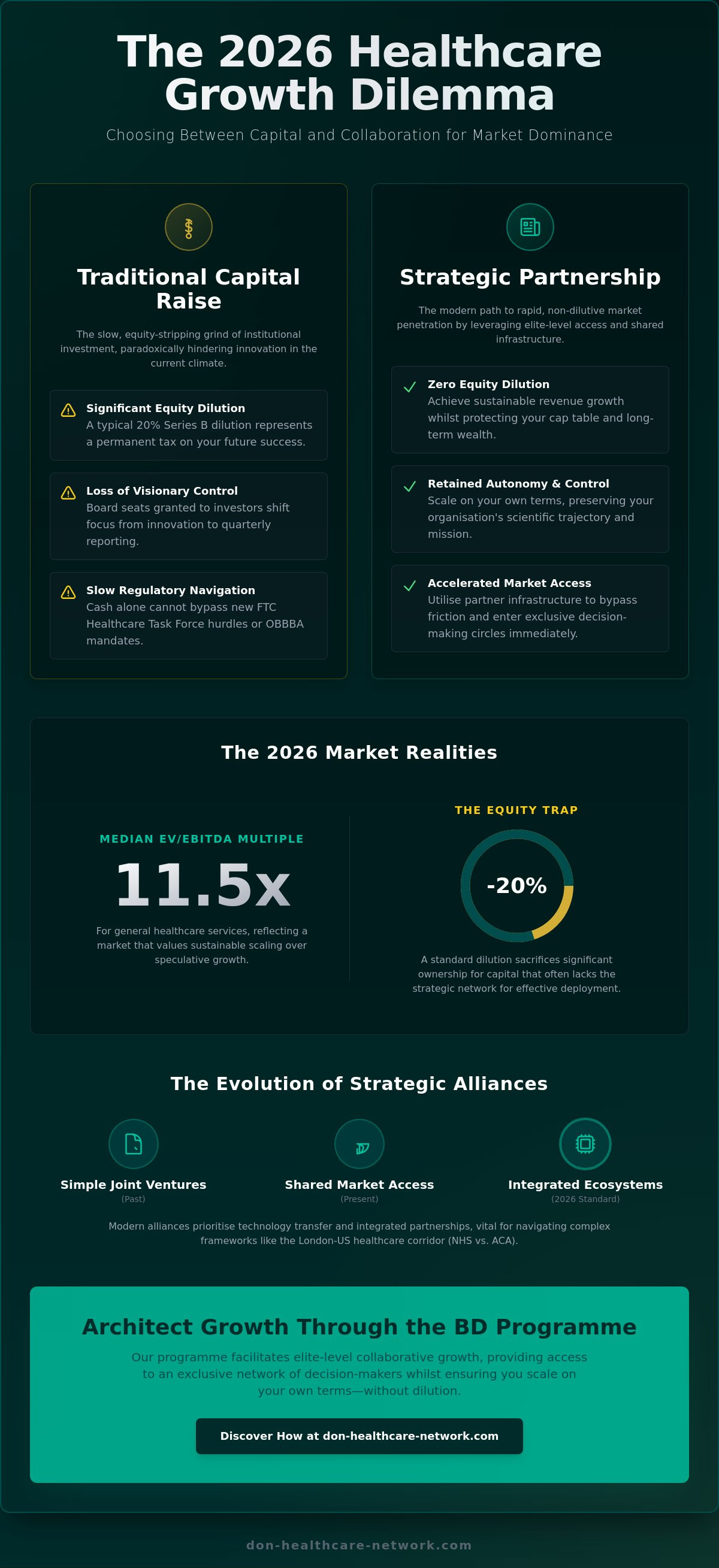
Chasing a massive Series C might be the most expensive mistake your healthcare organisation ever makes in this climate. Whilst the allure of a nine-figure check is undeniable, the reality of the 2026 market is that capital has become a commodity, yet elite-level access remains a rare luxury. When you weigh up healthcare strategic partnerships vs capital raise, you aren't just choosing a funding source; you're deciding between rapid, non-dilutive market penetration and the slow, equity-stripping grind of institutional misalignment. With median EV/EBITDA multiples for general healthcare services moderating to 11.5x this year, the cost of traditional equity is higher than ever for those who value long-term control.
You've likely felt the anxiety of watching your cap table erode whilst your speed-to-market remains stagnant despite a healthy bank balance. It's a common frustration for visionary leaders who realise that cash alone cannot bypass the regulatory hurdles of the new FTC Healthcare Task Force or the funding shifts within the One Big Beautiful Bill Act. You deserve a growth trajectory that preserves your ownership whilst granting you immediate entry into exclusive decision-making circles.
This article explores how to navigate the 2026 growth dilemma by prioritising alliances that offer more than just liquidity. You'll discover how to leverage high-level industry connections to achieve sustainable revenue growth without the typical dilution of a standard capital raise. We'll break down the mechanics of elite scaling to show you how to move with precision and professional authority.
Key Takeaways
- Identify why traditional "growth at all costs" models are failing in 2026 and how excessive capital can paradoxically slow your innovation.
- Compare the long-term impact of healthcare strategic partnerships vs capital raise to protect your equity and maintain control over your organisation's scientific trajectory.
- Discover how to utilise existing partner infrastructure to bypass regulatory hurdles and achieve rapid market expansion without the burden of equity dilution.
- Master the Capital Efficiency and Network Readiness tests to decide if your organisation is positioned for elite-level collaborative growth.
- Explore how the BD Programme facilitates access to an exclusive network of decision-makers whilst ensuring you scale on your own terms.
The Healthcare Growth Inflection Point: Cash vs. Collaboration
The era of "growth at all costs" died with the regulatory shifts of 2025. In 2026, the market demands measured confidence and proven execution over speculative scale. Healthcare leaders now face a pivotal choice between healthcare strategic partnerships vs capital raise. Whilst cash was once the ultimate lever, the March 2026 launch of the FTC Healthcare Task Force has complicated traditional consolidation. Organisations now find that excessive capital can paradoxically slow innovation. Large injections of cash often bring rigid reporting structures and board bloat that stifle the agility required to adapt to the community engagement mandates of the One Big Beautiful Bill Act (OBBBA).
Strategic partnerships offer a mechanism for "leveraged growth" without the weight of variable-rate debt. This approach allows you to scale by utilising a partner's existing infrastructure, bypassing the friction of building internal departments from scratch. You're ready for this elite-level shift when your clinical execution is de-risked but your market access remains restricted by a lack of high-level industry connections. It's about moving from a position of needing funds to a position of commanding influence.
The Evolving Definition of Strategic Alliances
In 2026, alliances have moved beyond simple joint ventures. The new standard involves integrated ecosystem partnerships that prioritises technology transfer and shared market access. This is particularly vital for the London-US healthcare corridor. Navigating the differences between NHS frameworks and the US ACA marketplace, which now sees out-of-pocket maximums hitting $10,600, requires more than just money. It requires a partner who already holds the keys to those specific regulatory kingdoms. These alliances allow for rapid expansion whilst maintaining the integrity of your original mission.
Capital Raise: The Traditional Path Under Scrutiny
Traditional Venture capital financing remains a viable route, but it's under intense scrutiny. Median EV/EBITDA multiples have moderated to 11.5x this year, down from the highs of 2024. Investors are no longer looking for "liquidity events" as their primary goal; they're demanding sustainable scaling and demonstrable ROI from AI-driven workflow automation. The shift in sentiment means that every pound of capital raised comes with higher expectations and tighter strings.
The Equity Trap in modern healthcare scaling occurs when a founder sacrifices significant ownership for capital that lacks the strategic network necessary to actually deploy that cash effectively.
The True Cost of a Healthcare Capital Raise: Beyond the Term Sheet
Accepting an institutional investment often feels like a victory. For many healthcare founders, it's the moment they believe they've finally "arrived". However, the math of 2026 suggests a more sobering reality. When you evaluate healthcare strategic partnerships vs capital raise, you must look beyond the immediate cash injection to the terminal value of your organisation. A standard 20% equity dilution in a Series B round doesn't just represent a slice of the pie. In a market where medical practices with over $5M in EBITDA command multiples of 10x to 12x, that 20% loss equates to millions in forfeited future wealth. It's a permanent tax on your success that no amount of operational efficiency can fully recover.
The governance shift is equally disruptive. Board seats granted to institutional investors fundamentally alter the trajectory of scientific innovation. Whilst traditional strategic approaches to funding often lean towards equity, the long-term cost is rarely confined to the balance sheet. You transition from a visionary leader to a manager of quarterly expectations. This reporting burden introduces significant bureaucratic friction, forcing clinical teams to prioritise "exit-ready" metrics over the patient-centric breakthroughs that defined the company’s early success.
Operational Friction and Misalignment
The conflict between patient-centric outcomes and investor returns is a persistent source of friction. Institutional capital demands a specific exit timeline, often forcing a premature sale before a technology has reached its full market potential. This pressure erodes agility. Funded companies frequently struggle to pivot quickly because every strategic shift must be vetted by a committee of non-scientific stakeholders. For the founder, the psychological impact is profound. You effectively become an employee of your own network, bound by covenants that limit your executive freedom.
The Opportunity Cost of Traditional Funding
Time is your most depleted resource. A typical capital raise requires months of roadshows, due diligence, and legal negotiations. This is time stripped away from product development and market expansion. In the current high-interest environment, the "burn rate" of a funded company can quickly outpace its growth rate if market access isn't immediate. Capital cannot buy the high-level industry connections required to navigate the 2026 regulatory landscape. Many leaders find that joining a structured BD Programme provides the necessary momentum and network access without these systemic drawbacks. You gain the speed of a funded entity whilst retaining the equity of a bootstrapped pioneer.
Strategic Partnerships: Scaling Healthcare Value Without Dilution
Scaling a healthcare organisation in 2026 requires more than just a surplus of liquidity; it requires strategic velocity. Whilst a capital raise provides a temporary financial cushion, it does nothing to dismantle the structural barriers to market entry. When choosing between healthcare strategic partnerships vs capital raise, the most ambitious founders are increasingly opting for access over ownership. By aligning with established industry pillars, you can leverage their existing commercial infrastructure to bypass the regulatory friction that often stalls funded startups for years. This isn't just about saving money. It's about buying time.
Synergistic market entry allows you to utilise a partner's pre-existing clinical validation and distribution networks. In a climate where the FTC Healthcare Task Force is intensifying oversight, piggybacking on a partner's established compliance framework is a masterstroke of efficiency. You effectively spread the risk of healthcare innovation whilst keeping your cap table pristine. This ensures that the founders, the original architects of the vision, remain firmly in the driving seat as the organisation hits its stride.
The Elite Networking Advantage
Success in the London-US healthcare corridor is often a matter of who you know, not what you spend. Partnering with an established centre of excellence creates a "Halo Effect" that grants your technology instant credibility amongst institutional buyers. Using elite platforms like DON Elite III allows you to identify these pre-vetted strategic allies with surgical precision. These connections accelerate commercial adoption in ways that a generic venture capital partner simply cannot match. You aren't just looking for a check; you're looking for a gatekeeper who can open doors across the Atlantic.
Revenue-Based Scaling vs Equity-Based Funding
Transforming a partnership into a direct sales channel creates a faster route to positive cash-flow than any funding round. By employing a "Success Fee" model, you align incentives for mutual growth rather than merely surviving until the next bridge round. This approach prioritises sustainable revenue over vanity metrics. A well-executed strategic alliance functions as a non-dilutive Series A that fuels your expansion whilst protecting your most valuable asset: your equity.
The Strategic Framework: Choosing Your Path to Market Dominance
Dominance in the 2026 market isn't a byproduct of luck. It's the result of a rigorous decision-making framework. Before committing to a specific growth vehicle, you must weigh healthcare strategic partnerships vs capital raise against your current internal capabilities. Start with a Network Readiness assessment. If your organisation lacks the high-level industry connections to influence payers or providers directly, a bank balance full of venture capital will simply sit idle. You can't buy trust in a closed ecosystem. You have to earn it or partner into it.
The Capital Efficiency test asks a simple question: can you achieve your next three clinical or commercial milestones through collaboration alone? If the answer is yes, raising equity is a strategic error. By 2030, the most valuable healthcare entities will be those that maintained lean cap tables whilst building massive, interconnected influence networks. Cash is a tool for building infrastructure, but partnerships are the tools for building market share. In a high-interest environment, your growth rate must significantly outpace your burn rate to remain viable.
When a Capital Raise is Unavoidable
There are moments when networking isn't enough. High-intensity infrastructure requirements, such as building proprietary manufacturing centres or funding multi-site Phase III trials, often demand significant liquidity. In these scenarios, use capital as a "mop-up" strategy. Validate your model through strategic alliances first, then raise capital from a position of strength to fund the heavy lifting. A clean cap table, preserved through early-stage partnerships, makes you far more attractive to the elite institutional partners who provide late-stage growth capital. It ensures you aren't raising money out of desperation, but for acceleration.
When Strategic Partnerships are the Superior Choice
If you're entering highly regulated or "closed" systems like the NHS or major US payer networks, partnerships are the superior choice. The primary hurdle in these markets isn't cash; it's credibility. You need a partner who already possesses the "trust equity" required to move through the procurement process. Leveraging a specialised healthcare BD Programme allows you to bridge this gap without sacrificing ownership. It provides the structured approach needed to scale within complex regulatory environments whilst keeping the founders in total control of the organisation's destiny. This path prioritises commercial adoption over simple liquidity.
Architecting Growth Through the DON Healthcare Network BD Programme
The debate surrounding healthcare strategic partnerships vs capital raise often ignores a sophisticated middle ground. Many executives believe they must choose between the slow grind of bootstrapping or the equity-stripping terms of institutional funding. The DON Healthcare Network dismantles this binary choice. Through our structured BD Programme, we provide a definitive framework for organisations to scale without premature equity loss. We focus on removing the friction inherent in identifying and securing elite-level alliances. This allows you to deploy your technology or service into new markets with the speed of a funded entity whilst maintaining the cap table of a private powerhouse.
Success in the transatlantic corridor requires more than just a presence; it requires a pedigree. Bridging the gap between London’s clinical innovation and the massive scale of the US market is a complex undertaking. The BD Programme acts as a strategic bridge, providing the pre-vetted connections and regulatory insights necessary to navigate these disparate systems. We position your organisation for high-stakes success by aligning you with the DON Elite III network, ensuring your growth is built on a foundation of professional authority and institutional credibility.
The DON Elite III Advantage
Capital can buy many things, but it cannot buy a seat at the table with the industry’s most influential decision-makers. The DON Elite III network offers a premier circle of influence that functions as a strategic asset for healthcare executives. This is about more than simple networking. It is about access to a curated ecosystem of centres of excellence and high-level payers. By joining this circle, you benefit from a "Halo Effect" that significantly reduces your commercial sales cycles. Our members have consistently demonstrated that non-dilutive growth is not just a theoretical goal but a practical reality when you have the right gatekeepers in your corner.
Next Steps for the Ambitious Healthcare Executive
Your current growth trajectory is either limited by your capital or accelerated by your network. If you find yourself spending more time on investor roadshows than on market development, it is time to evaluate your path against the DON framework. We invite you to move beyond the traditional limitations of equity-based scaling. Our process is efficient, results-oriented, and designed for those who demand excellence. You can Apply to the DON Healthcare Network today to begin the process of accelerating your market entry. Take the first step toward elite growth and secure your organisation's position as a leader in the 2026 healthcare market.
Secure Your Position in the Elite Healthcare Ecosystem
The decision between healthcare strategic partnerships vs capital raise ultimately defines your organisation's terminal value. Whilst a capital injection offers immediate liquidity, it often introduces governance friction that can stifle scientific breakthrough and clinical agility. True market dominance in 2026 belongs to those who prioritise elite-level access over equity dilution. By leveraging existing infrastructures in the London and US markets, you can bypass the bureaucratic hurdles of new regulatory task forces whilst maintaining total control of your cap table.
The path to non-dilutive growth requires a structured approach and a pre-vetted circle of influence. Our specialised London and US healthcare market expertise allows you to bridge the gap between innovation and commercial scale without the usual sacrifices. You don't have to navigate this dilemma alone. Trading the uncertainty of a roadshow for the certainty of a high-performance partnership is the mark of a truly visionary leader.
Explore the DON Healthcare BD Programme for Strategic Scaling and gain exclusive access to the DON Elite III network today. It is time to trade the volatility of traditional funding for the stability of strategic alliances. Your vision deserves a legacy, not just a liquidity event.
Frequently Asked Questions
What is the main difference between a healthcare strategic partnership and a capital raise?
The primary distinction lies in the exchange of value; a capital raise swaps equity for liquidity, whereas a strategic partnership swaps shared resources for market access. In the debate of healthcare strategic partnerships vs capital raise, the former allows you to scale via a partner's infrastructure. This avoids the debt-like pressure of institutional funding whilst keeping your cap table lean. It's a choice between owning a smaller piece of a funded entity or a larger piece of a connected one.
How does equity dilution impact a healthcare founder in the long term?
Equity dilution permanently reduces a founder's terminal wealth and executive authority. By forfeiting ownership for cash, you aren't just losing a percentage; you're losing the ability to steer the organisation's scientific or clinical trajectory without institutional interference. In a market where high-performing practices command multiples of 12x EBITDA, that early-stage dilution translates into a significant loss of multi-million pound future valuations. It's a permanent tax on your innovation and future control.
Can a strategic partnership replace a Series B funding round?
A strategic partnership can effectively replace a Series B round by providing the market penetration usually funded by that capital. Instead of raising millions to build a sales force or distribution network, you leverage a partner's pre-existing channels. This non-dilutive approach allows you to hit the same commercial milestones without the bureaucratic friction of a traditional funding round. It preserves your equity whilst accelerating your speed-to-market through established centres of excellence.
What are the hidden costs of raising capital for a healthcare startup?
Beyond interest rates, the hidden costs include the reporting burden, governance shifts, and the immense opportunity cost of founder time. Preparing for a capital raise requires months of roadshows and due diligence that strip attention away from clinical development. Once funded, the transition from visionary leader to manager of quarterly investor returns creates operational friction. These "soft" costs often outweigh the face value of the capital, slowing innovation through committee-led decision-making processes.
How do I find high-level healthcare partners in London or the US?
Accessing high-level partners in the London-US corridor requires entry into exclusive, pre-vetted circles of influence. Traditional networking is often too slow and lacks the professional authority needed to reach decision-makers at major payers or health systems. Utilising a specialised BD Programme provides a structured gateway to these markets. It bypasses the noise of the open market, placing your technology directly in front of the gatekeepers who control procurement and clinical adoption.
What is the role of a business development programme in healthcare scaling?
A business development programme acts as a strategic architect for your organisation's expansion. It provides a methodical framework to identify, vet, and secure alliances that offer non-dilutive scaling. By removing the friction of finding elite partners, it allows your team to focus on core innovation. This structured approach ensures that every partnership is aligned with your long-term vision, preventing the mission creep that often occurs when chasing misaligned institutional capital or venture funding.
Is a success fee common in healthcare strategic alliances?
Success fees are increasingly common in strategic alliances as they align the incentives of both parties toward actual growth. Unlike the fixed management fees of private equity, a success fee model ensures that your partner only profits when you achieve specific commercial or clinical milestones. This performance-based structure protects your cash-flow whilst providing a powerful motivator for your strategic ally to open the right doors and accelerate your market penetration across new territories.
How does the DON Elite III network facilitate healthcare growth?
The DON Elite III network facilitates growth by granting immediate credibility through its prestigious "Halo Effect". Membership provides an exclusive pipeline to decision-makers within the world's most sophisticated healthcare ecosystems. By connecting you with pre-vetted institutional partners, it eliminates the months of vetting usually required to build trust. This network doesn't just provide introductions; it provides the professional authority necessary to close high-stakes agreements and secure your organisation's future in a competitive market.