

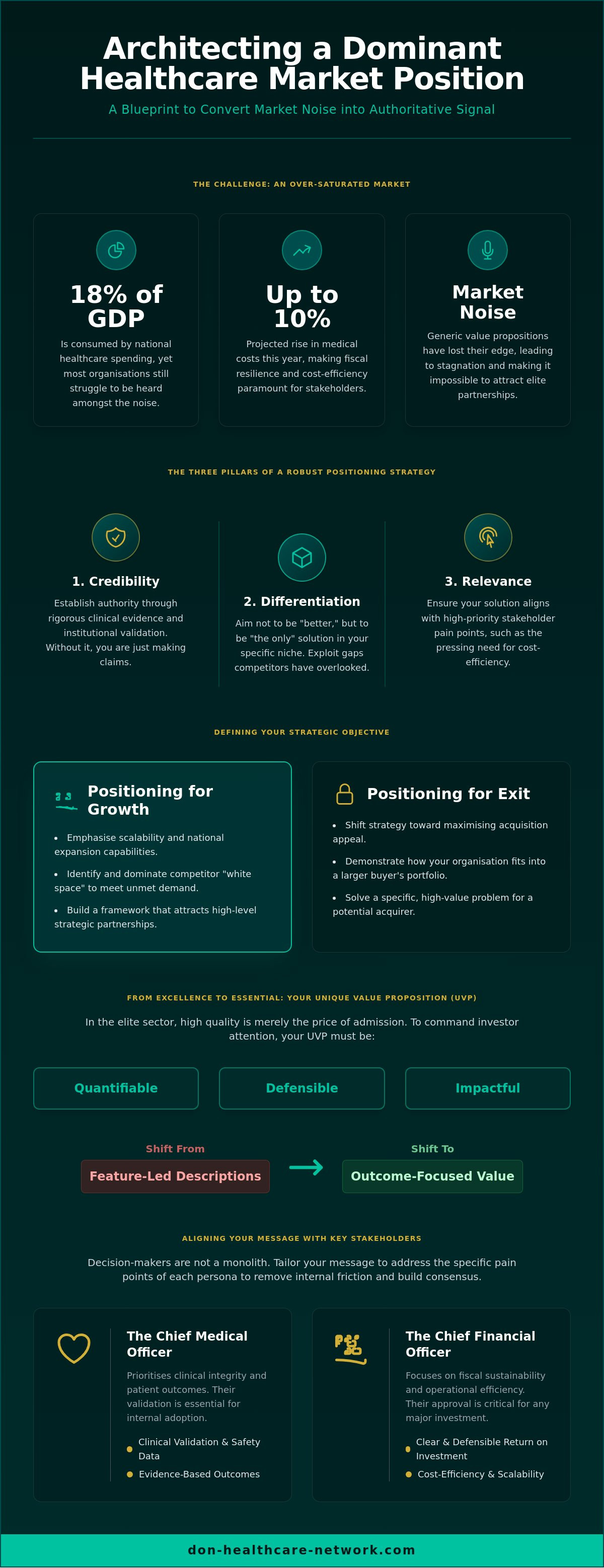
National healthcare spending now commands 18% of GDP, yet most organisations are still struggling to be heard. If you find your complex value proposition is getting lost amongst the noise of an oversaturated market, you're likely struggling with misaligned signals that stall your national expansion. You aren't alone in feeling that traditional differentiation has lost its edge in a sector where costs are projected to rise by up to 10% this year. This guide promises to help you architect a sophisticated healthcare market positioning strategy that commands the attention of high-level stakeholders and institutional partners. We'll move beyond generic marketing to provide a clear blueprint for market dominance. You will learn how to build a scalable framework that secures your position as an indispensable industry pillar whilst accelerating strategic growth across the sector. By the end of this template, you'll have the tools to convert market noise into a clear, authoritative signal that attracts high-level capital and elite partnerships.
Key Takeaways
- Define the intersection of unique capability and market demand to establish a dominant, defensible presence in the 2026 landscape.
- Identify a quantifiable Unique Value Proposition by analysing competitor behaviour to uncover high-value gaps in service delivery.
- Utilise a modular healthcare market positioning strategy template to crystallise your organisation's stance and command immediate stakeholder attention.
- Leverage elite industry networks as a strategic multiplier to secure high-level partnerships and accelerate national expansion.
- Shift from broad market noise to a focused, high-impact narrative that aligns with the rigorous requirements of institutional investors.
Defining the Healthcare Market Positioning Strategy Framework
Market positioning is the deliberate act of designing an organisation’s offering and image to occupy a distinct place in the minds of target stakeholders. It isn't merely a marketing exercise. It's a strategic imperative. In 2026, your healthcare market positioning strategy must be the precise intersection where your unique technical capability meets urgent market demand. Whilst brand identity describes who you are, market position dictates where you sit amongst competitors. Identity is internal; position is relative. In a sector where national healthcare spending has reached 18% of GDP, being "another provider" is a recipe for stagnation. You must define your coordinates with surgical precision.
The US healthcare sector is defined by rigorous regulation and high barriers to entry. With 2026 enforcement of Hospital Price Transparency (HPT) regulations and the Medicare Negotiation Programme in full effect, generic value propositions are a liability. High-level stakeholders require a framework that acknowledges these complexities. Refining your healthcare market positioning strategy allows you to bypass the noise of oversaturated markets and speak directly to the requirements of institutional capital. Effective Positioning (marketing) ensures your value is seen as an absolute necessity rather than an optional service.
The Three Pillars of Strategic Positioning
A robust position rests on three foundational elements. Credibility is your first requirement. You establish authority through clinical evidence and institutional validation; without it, you're just making claims. Differentiation is the second pillar. You shouldn't aim to be better than the competition. You must aim to be "the only" solution in your specific niche. Finally, Relevance ensures your solution aligns with high-priority pain points. With two-thirds of Americans reporting that medical costs are a financial strain, positioning that focuses on cost-efficiency and transparency is currently paramount.
Positioning for Growth vs. Positioning for Exit
Your strategic stance depends on your ultimate objective. If you're positioning for growth, your framework must emphasise scalability and national expansion. You're looking for the "white space" where competitors are failing to meet demand. If you're positioning for an exit, your strategy shifts toward acquisition appeal. You must demonstrate how your organisation fits into a larger portfolio or solves a specific problem for a potential buyer. Market sentiment plays a critical role here. By architecting a successful entry that mirrors current investor appetites, you ensure your organisation isn't just a participant, but a leader. It's a calculated move that removes friction from the path to a definitive conclusion.
Identifying Your Unique Value Proposition in the Elite Sector
Excellence is a baseline. It's never a differentiator. In the high-stakes environment of private equity and venture capital, claiming high quality is merely the price of admission. To command the attention of institutional investors, your Unique Value Proposition (UVP) must be quantifiable, defensible, and immediately impactful. You must move beyond feature-led descriptions. Effective healthcare marketing strategies require a shift toward outcome-focused value statements that address the systemic pressures of 2026. With medical costs projected to rise by 8.5% to 10% this year, your UVP needs to solve for fiscal resilience as much as clinical efficacy.
Analysing competitor behaviour allows you to identify gaps in service delivery and innovation that others have overlooked. Most organisations focus on patient-facing convenience whilst ignoring the operational friction that plagues large-scale systems. Your healthcare market positioning strategy should exploit these blind spots. By framing your solution as a tool for administrative automation or predictive analytics, you position your organisation as a visionary partner rather than a commoditised vendor. This transition from "better" to "essential" is the hallmark of elite market presence.
Stakeholder Mapping and Persona Alignment
Decision-makers in healthcare aren't a monolith. You must identify the gatekeepers who actually hold the power to partner or invest. A Chief Medical Officer seeks clinical validation and patient safety data. A CFO demands fiscal sustainability and a clear return on investment. You must tailor the message to each persona. Building a consensus-driven positioning strategy for complex organisations ensures that every stakeholder sees their specific pain point addressed. It's about removing internal friction before you ever reach the boardroom.
Evidence-Based Differentiation Strategies
Data is your most potent leverage. You must use it to prove market efficacy whilst maintaining absolute regulatory transparency. Social proof is the currency of elite circles; institutional validation carries more weight than any marketing campaign. Organise your internal assets to support your external claims with rigorous vetting. If you're seeking to refine these signals and connect with high-level capital, exploring an elite industry network can provide the necessary institutional weight. Credibility isn't given. It's built through a steady pulse of verified results and strategic alliances.
The Strategic Positioning Template: A Blueprint for Scaling
Precision in execution requires a framework that strips away ambiguity. This modular template allows executives to crystallise their market stance in five minutes, moving from broad aspirations to a definitive, defensible signal. It's designed to be used as a living document during the Healthcare BD Programme, ensuring your growth is architected rather than accidental. A successful healthcare market positioning strategy must be resilient enough to withstand the projected 2026 medical cost increases whilst remaining flexible enough to pivot as regulatory shifts occur.
Brevity is power. In high-stakes networking, your value must be immediately clear. Use punchy, declarative statements that command attention. This template forces you to stress-test your positioning against potential market disruptions, ensuring your organisation remains an institutional pillar even as competitors falter. By focusing on the mechanics of engagement, you remove the friction that often stalls national expansion.
The Executive Positioning Matrix
To scale with efficiency, you must map your trajectory across three distinct phases. First, define your Current State: a brutally honest assessment of where you sit today in the national market. Next, identify your Target State: the most lucrative and defensible position for 2026 based on emerging demand. Finally, isolate The Delta. This represents the specific strategic moves required to bridge the gap between your current footprint and market dominance. This modular approach ensures every resource is deployed with maximum impact.
Crafting Your "Only-ness" Statement
Authority is diluted by generic language. To stand out, you must craft an "Only-ness" statement that follows this specific template: "We are the only [category] that [benefit] for [audience] whilst [unique constraint]." This structure forces you to identify a truly unique capability that cannot be easily replicated by competitors. You must eliminate "fluff" words that signal a lack of depth. Terms like "world-class", "leading", and "innovative" have lost their currency in elite circles. Refining this statement for high-level networking and investor decks creates a narrative arc that feels both urgent and deeply organised. Secure your place amongst the industry's visionaries by deploying the DON Elite III framework to architect your global growth.
Leveraging High-Level Networks for Market Dominance
Market positioning is validated by the company you keep. Elite networks act as a force multiplier for your brand identity. Strategic growth isn't a result of luck. It's the outcome of being in the right room with the right gatekeepers. You must transition from a generic market entry to an "Elite Advantage" approach. This ensures you're viewed as a strategic ally rather than just another vendor. In a sector where healthcare cases accounted for over 80% of the record $6.8 billion in False Claims Act settlements in 2025, institutional trust is more than a preference. It's a necessity for survival.
Being an outsider is expensive. Misaligned market signals lead to inefficient growth and missed opportunities. By aligning your organisation with established industry pillars, you inherit a level of credibility that takes years to build independently. Your healthcare market positioning strategy should prioritise these high-level alliances. They provide the necessary validation to convince institutional investors and wealthy stakeholders of your long-term viability. When you move amongst the industry's elite, your value proposition is assumed rather than questioned.
The DON Elite III Philosophy
Exclusive networking platforms accelerate a healthcare market positioning strategy by providing immediate institutional weight. Through DON Elite III, you access high-level industry connections that validate your Unique Value Proposition (UVP) before you even pitch. This removes traditional barriers to entry through strategic introductions and vetted partnerships. It's about efficiency. It's about precision. It's about securing your place in the circle of influence whilst others are still trying to find the door. This philosophy treats networking not as a social exercise, but as a core component of your strategic infrastructure.
Next Steps for Strategic Expansion
Your first move is to conduct a positioning audit. Does your current presence reflect your true ambitions? Review your stakeholder engagement plan against the template provided earlier in this guide. Ensure every touchpoint reinforces your "Only-ness" statement. If your current signals are misaligned, consider enrolling in a specialised healthcare BD programme to refine your market stance. Action is the only antidote to stagnation. Review your assets, align your network, and execute with the confidence of a market leader.
Mastering the Strategic Coordinates of 2026
Dominating the US healthcare sector requires more than operational excellence. It demands a sophisticated healthcare market positioning strategy that aligns your unique capabilities with the high-stakes requirements of institutional capital. By crystallising your "Only-ness" statement and leveraging elite networks, you move from being a market participant to a visionary pillar. You've seen how a modular framework and evidence-based differentiation can remove the friction from national expansion. Now, it's time to execute with the precision that the 2026 landscape demands.
Strategic growth is a deliberate choice. You can continue to navigate the market noise alone, or you can leverage the expertise of partners who understand the intricacies of specialised scientific sectors and private equity. The path to market dominance is paved with vetted partnerships and strategic introductions that accelerate your trajectory. We're here to ensure your organisation doesn't just enter the market, but defines it. Success is the result of calculated moves made within the right circles of influence.
Architect your growth with the DON Healthcare Network. Gain access to specialised business development and an exclusive circle of high-level industry connections. Our expertise in strategic growth ensures your market entry is both efficient and defensible. The future of the sector belongs to those who act with precision and purpose today.
Frequently Asked Questions
What is the most common mistake in healthcare market positioning?
The most frequent error is attempting to appeal to every stakeholder segment simultaneously with a generic value proposition. Broad messaging dilutes your authority and signals a lack of specialised expertise to institutional investors. Elite organisations avoid this by focusing on a narrow, defensible niche where their unique capability is an absolute necessity. When you try to be everything to everyone, you become a commoditised vendor rather than a strategic ally.
How often should a healthcare company revisit its positioning strategy?
You should review your healthcare market positioning strategy at least annually or whenever significant regulatory shifts occur. The 2026 landscape is particularly volatile due to new Hospital Price Transparency enforcement and Medicare drug price negotiations. A static stance is a liability in a high-stakes environment. Quarterly audits of market signals ensure your organisation remains aligned with the evolving requirements of high-level capital and institutional partners.
Can a small healthcare startup compete with established giants through positioning?
Yes, startups can dominate by exploiting the "agility gap" that larger, legacy organisations often ignore. Whilst giants struggle with diluted messaging and internal friction, a smaller entity can position itself as a hyper-specialised disruptor. By solving a specific, high-priority problem like administrative automation with surgical precision, you become the only viable choice for a specific niche. This allows you to bypass traditional barriers and secure elite partnerships early.
Is market positioning different for B2B versus B2C healthcare companies?
B2B positioning focuses on systemic efficiency and fiscal return, whilst B2C centres on trust and individual patient outcomes. B2B stakeholders like hospital CEOs or private equity partners require quantifiable evidence of scalability and risk mitigation. Conversely, B2C audiences prioritise accessibility and reputation. Both require a clear "Only-ness" statement, but the proof points must be tailored to the specific gatekeepers who hold the power to partner or invest.
How do regulatory requirements impact healthcare market positioning?
Regulations act as the boundaries of your defensible market space and can be leveraged as a competitive asset. Incorporating a robust healthcare market positioning strategy that addresses the Healthcare Cybersecurity and Resiliency Act of 2026 proves institutional maturity. Compliance isn't just a legal hurdle. It's a positioning tool that signals reliability to risk-averse stakeholders. It transforms a mandatory requirement into a powerful differentiator that attracts high-level capital.
What role does digital transformation play in positioning for 2026?
Digital transformation is the primary engine for demonstrating operational scale and modern authority in the current market. With 90% of providers expected to use AI for ambient note generation by the end of 2026, technological adoption is no longer optional. If your positioning doesn't reflect these shifts, you'll be viewed as a legacy entity. Digital integration signals that your organisation is ready for rapid, automated expansion and high-level strategic engagement.